
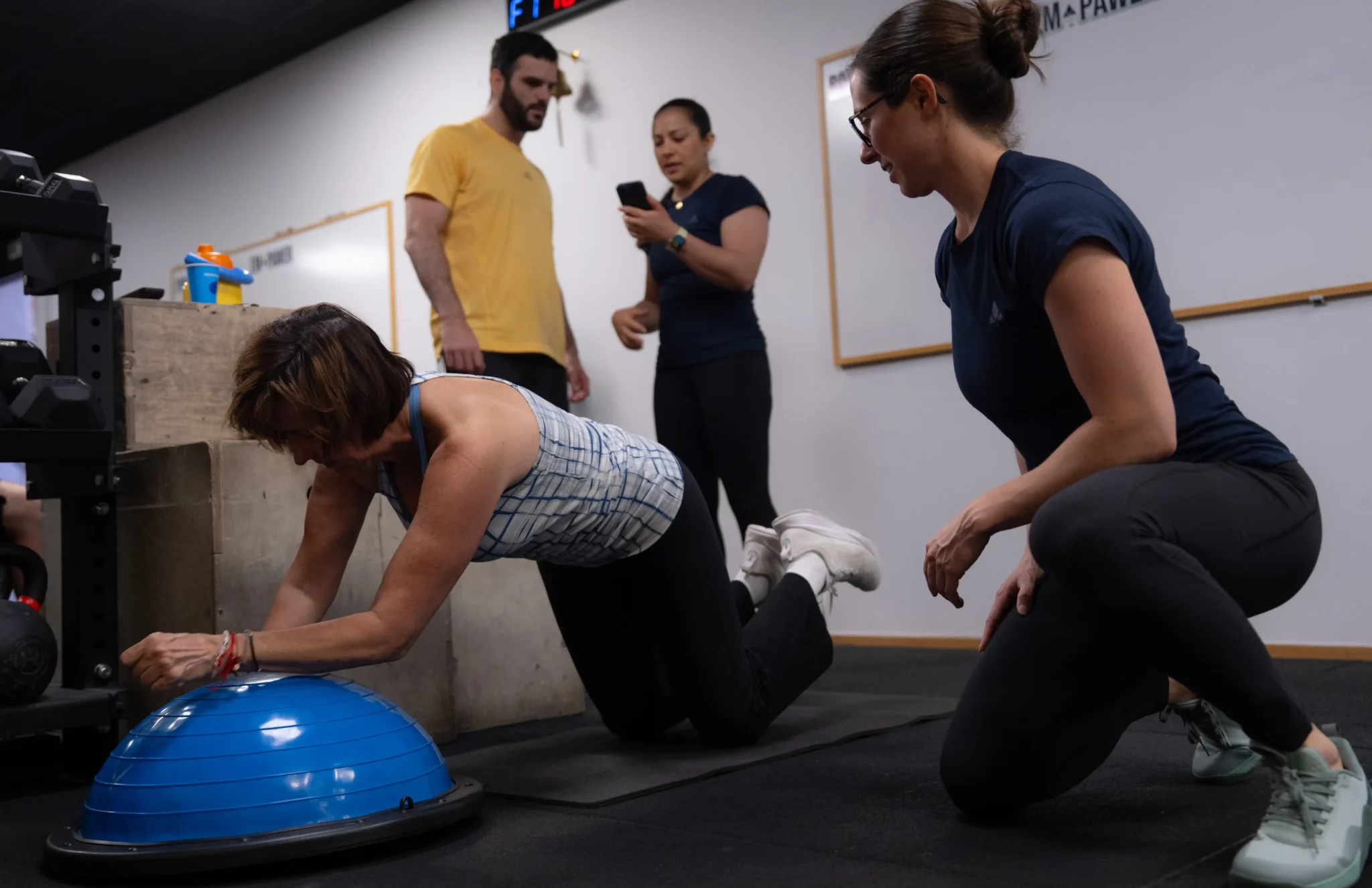
Discover how to care for your intimate area through the consistent and appropriate practice of specialized techniques. At Empawer Fitness, we know that performing pelvic floor exercises significantly improves your health and daily well-being, providing greater safety in your routines and in your daily life.
What is the pelvic floor and why should you do pelvic floor exercises?
The pelvic floor is a set of ligaments and muscles that act as a hammock at the base of the pelvis. Knowing the anatomy of this area helps us understand why it is vital to strengthen the pelvic floor to prevent long-term health problems.
Function of the pelvic floor muscle
Each muscle of the pelvic floor performs the task of supporting the pelvic organs. These muscles help to support the bladder and other organs such as the uterus, vagina, and rectum. By contracting and relaxing this area consciously, proper control of urine is ensured and stability is improved in the abdominal and lower region.
Consequences of weakening the pelvic floor muscles
Factors such as weight gain, menopause Giving birth can weaken the pelvic area. If the strength of the pelvic floor is lost, problems such as:
- Urinary incontinence, especially stress urinary incontinence when coughing, laughing or jumping.
- Prolapse of the pelvic organs.
Therefore, performing exercises to strengthen the pelvic floor is essential to regain firmness and ensure the prevention of prolapse.
Step-by-step Kegel exercises: How to do the exercises correctly
Learning how to do the Kegel exercises correctly (or Kegel exercises) guarantees that the pelvic floor muscles regain their ideal tone without causing unnecessary fatigue. Follow this Kegel step by step:
- Identify the muscles: To find the right muscle, try stopping the flow of urine when you go to the bathroom (do it only once to identify them; don't do it as a routine). You will feel the tension around the vagina or rectum.
- Posture: Lie down or sit comfortably. Concentrate on contracting your muscles.
- Execution: Contract the area and hold the position for a few seconds (ideally 5 seconds). Then, relax again.
- Ideal routine: Perform 5 to 10 repetitions. To obtain results, it is recommended to do three sets of ten repetitions several times a day.
Techniques to strengthen the pelvic floor muscles
How to contract and relax without additional tension
To master the technique, it is necessary to focus on strengthening the pelvis without straining the abdominal muscles, the thigh or the gluteal muscles. Avoid holding your breath. This repetitive dynamic optimizes support and helps you achieve a stronger pelvic floor.
Rapid contractions and their importance
In addition to sustained contractions, performing quick contractions helps the muscles respond immediately to unexpected efforts. You should gradually increase the contraction time to gain strength.
Varied exercises: Kegel for men and women
Kegel exercises for men
Although they are often associated with female health, Kegel exercises for men are extremely effective in caring for the prostate and improving urinary control. By performing Kegel exercises, muscle function is optimized and age-related weakening is prevented.
Pelvic floor exercises for women
Women can greatly benefit from doing Kegel exercises to strengthen the area at key stages. They help restore muscle tone. after the birth And they protect during menopause. Doing Kegel exercises regularly restores lost strength and helps to hold the bladder in place.
Benefits of exercises to strengthen the pelvic floor
Integrate the pelvic floor exercises into your conditioning routine it brings incredible advantages:
- Improvement in sexual health: The constant practice of these exercises has a positive impact. By exercising the pelvic floor, sensitivity is intensified, helping to improve sexual function and overall sexual health.
- Strengthen this area and the core: When performing the Kegel exercises, the abdomen and gluteal muscles are indirectly involved, achieving exceptional stability.
- Total control: It helps strengthen the muscles of the pelvic floor to prevent leakage.
Frequently Asked Questions (FAQs) about pelvic floor exercises
1. How many times a day should I perform the Kegel exercises?
The ideal is to perform these specific exercises 3 to 5 times a day. You can do one set in the morning, another in the afternoon, and another in the evening.
2. How long will it take for me to notice that my muscles are stronger?
If you are consistent in exercising and complete your three daily sets, you will start to notice that your muscles become more firm and controlled within a period of 4 to 6 weeks.
3. Can I do pelvic floor exercises if I have never had a childbirth?
Absolutely! Exercises to strengthen the pelvic floor are recommended for anyone, regardless of whether they have had children or not, as they prevent incontinence and improve long-term health and well-being.
4. Is it normal for me to have pain in my abdomen or back when exercising?
No, it shouldn't hurt. If you feel tension in those areas, it means you're squeezing your abdomen, back, or gluteal muscles instead of focusing on the pelvic floor muscles. Remember to isolate the movement.
Strengthen your pelvic floor with Empawer Fitness
At Empawer Fitness (Madrid), we design programs adapted to every stage of your life so that you work on your pelvic floor and core muscles using correct and safe techniques. Book your initial evaluation and start training with a plan tailored to your needs.